

Mersen Solutions for Mission-Critical Electrical Systems and Applications
-
For the most critical applications, Mersen has you covered. Amp Trap® fuses limit damaging currents during faults, while Surge-Trap® Surge Protective Devices (SPDs) divert surges, shielding critical equipment from electrical damage and downtime during operations.
-
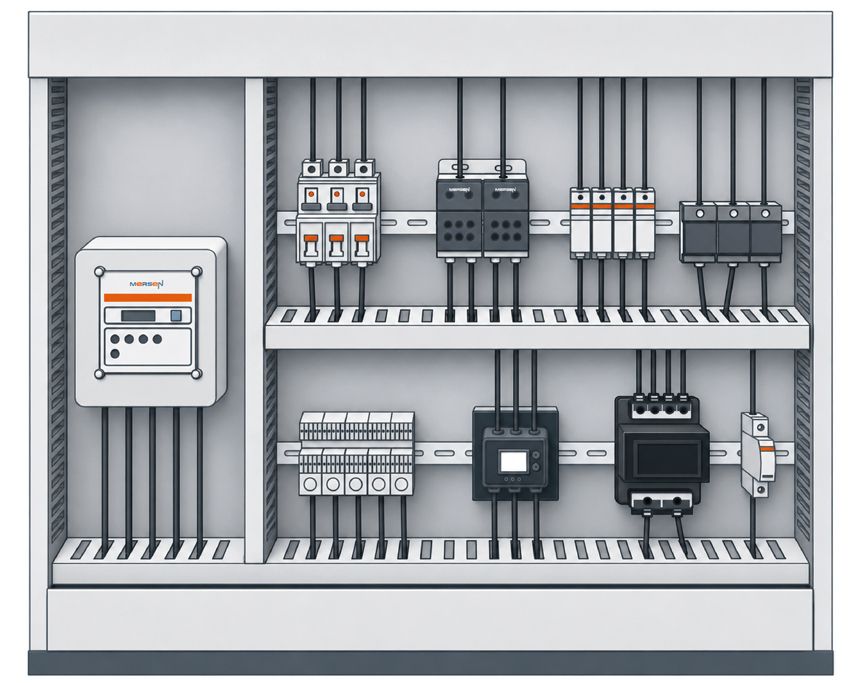
Mersen Components in a Typical Switchboard
-
STZ Series
-
Fused Disconnect Switch
-
Compact Power Distribution Block
-
UltraSafe™ Class CC Fuse Holders
-
Surge-Trap® Pluggable STP-75 Series
-
-
Mission-Critical Electrical Systems
A mission critical power system refers to an electrical power infrastructure that is designed to support essential loads or operations that cannot tolerate power interruptions. These systems are typically found in facilities where power disruptions can have severe consequences, such as data centers, hospitals, telecommunications centers, and industrial plants.
To maintain up-time with this equipment, various philosophies and methods need to be considered:- Redundancy: Critical power systems often incorporate power-source redundancy at various levels to minimize the risk of power interruptions. This can include alternate power sources, distribution paths, and equipment.
- Reliability: A critical power system also resistant to failures, and protection systems operate as designed.
- Selectivity: Selective Coordination isolates power system issues to the smallest possible section, minimizing overall impact on up-time.
- Cascading Surge Protection: A system design approach that maximizes the protection of electronic circuitry providing redundancy and placement near high exposure areas and near sources of internally generated surges.
- Preventive Maintenance and Monitoring: A proactive strategy to eliminate unplanned downtime, extend equipment life, and ensure safety.
Mission Critical Power Systems may feed or be comprised of the following subsystems and equipment which need to be protected from overcurrent and over-voltage:
- Main Electrical Equipment from utility and backup sources, including Switchgear and Switchboards (NEC Article 700.8)
- Life Safety Systems: Emergency power systems may power critical life safety systems, such as emergency communication systems, public address systems, emergency medical equipment, and security systems, to maintain essential services during power outages (NEC Article 700.8, 620.51(E)).
- Emergency lighting: Emergency power systems provide backup power to emergency lighting systems, including exit signs and egress lighting, to ensure safe evacuation during power outages (NEC Article 700.8).
- Fire Protection Systems: Emergency power systems often support fire protection systems, including fire alarms, smoke detectors, fire pumps, and sprinkler systems. These systems are crucial for ensuring early detection and suppression of fires during power disruptions (NEC Article 695.15).
- Manufacturing Environments: Continuous process facilities, for manufacturing, food and beverage, oil and gas, chemical processes, data centers, and semiconductor labs have enormous opportunity costs during electrical outages and can require significant startup time to bring back online (NEC Articles 409.70, 670.6).
-
System Architecture and Protection
The impact of downtime with these systems can manifest itself in safety problems, lack of productivity, and severe financial losses. Solid engineering design, maintenance and planning is key to keeping these systems online.
Mersen provides industry-leading protection components and solutions. Surge protection is required on essentially any type of equipment to protect the electronics and firmware from destruction, disruption, and degradation, and to comply with codes. Current-limiting fuses provide superior sub-cycle fault interrupting allowing for easy selective coordination while limiting dangerous and damaging fault currents.
-
System Architecture
-
Switchgear (UL 1558)
Low Voltage Switchgear is power distribution equipment located at the service entrance of most facilities. Its main distinction is compartmentalization, where each major operational group is separated by grounded metal barriers to enhance safety and reliability as they provide power to downstream Switchboards and Panelboards. They typically are rated for up to 1000V and up to 10,000A. Switchgear components can include:
- Draw-out circuit breakers with advanced electronic controls [SPD, F/H]
- Control Power Transformers (CPTs): Stepping down voltage for various system loads [SPD, F/H, PDB]
- Instrument Transformers: Current Transformers (CTs), Potential Transformers (PTs) [SPD, F/H, PDB]
- Metering: Digital or analog ammeters, voltmeters, and power quality monitors [SPD, PDB]
- Interlocks: Mechanical and electrical safety locks to prevent unsafe operations [SPD, PDB]
- Heaters: Used to prevent condensation inside the enclosure [SPD, F/H,PDB]
- Cooling Systems: Used to dissipate excess heat in high amperage applications [SPD, F/H, PDB]
- Smart Grid and IoT Integration [SPD, PDB]
High fault currents often necessitate fuses. With installation locations at the service entrance, Type 1 SPDs with robust components are necessary to protect from external sources like induced lightning surges, grid switching, and reflection amongst others.
-
Switchboards (UL 891)
A switchboard is an electrical power distribution board with a dead-front that serves as a distribution hub to safely receive electrical power and route it to multiple feeder circuits. These are typically 1000V or less, up to 6000A, and can integrate the same components as listed for Switchgear depending on the electrical distribution design. Switchboards provide power various systems throughout facilities including:
- Secondary Power Distribution Systems: MCCs, Transformers, Panelboards [SPD, F/H, CPP]
- Industrial and Process Machinery [SPD, F/H, PDB, CPP]
- Commercial/Industrial HVAC: Boilers, Chillers, Cooling Towers [SPD, F/H, PDB]
- Data Centers: PDUs, UPS Systems, Buss Systems, CRAC Units [SPD, F/H, CPP]
- Alternative Energy and Power Generation Systems: ATS, Generator, Solar, Wind, BESS Systems, EV Charging [SPD, F/H, PDB, CPP]
-
Panelboards (UL 67)
Panelboards are the electrical distribution boards where power is split into smaller, protected branch circuits for commercial, industrial, and residential buildings. Panelboards are typically 1000V or less, up to 1200A. These protected circuits provide power for various systems throughout facilities including:
- Lighting and receptacles [SPD, F/H]
- HVAC [SPD, F/H]
- IT/Communication/Security and Surveillance Infrastructure [SPD]
- Building Automation [SPD]
- Kitchen Equipment [SPD]
- Life Safety Systems [SPD]
- Elevators, Escalators, Moving Walkways [SPD, F/H]
- Other Specialized Equipment [SPD, F/H, PDB, CPP]
-
MCC (UL 845)
A Motor Control Center is a centrally located, floor-mounted assembly of enclosed sections designed to control, protect, and distribute power to electric motors. MCC’s are typically 1000V or less, up to 4000A. MCCs can include:
- Variable Frequency Drives (VFDs) [SPD, F/H, CPP]
- Motor Starting & Control Components [SPD, F/H, PDB]
- Metering Equipment [SPD, PDB]
- Communication Modules [SPD, PDB]
- Control Transformers [SPD, F/H, PDB]
- HMIs, Controls, Emergency Stops [SPD, F/H, PDB]
-
Control Panels (UL 508A)
An industrial control panel is a centralized enclosure containing electrical components that monitor, manage, and automate machinery or industrial processes. Industrial Control Panels are typically 1000V or less and can include:
- Power Distribution and Disconnects [SPD, F/H, PDB]
- Circuit Protection: Overcurrent and Overvoltage [SPD, F/H, PDB]
- Motor Controls: VFDs, Relays, Soft Starters, Contactors [SPD, F/H, PDB]
- Automation, Controls, and Logic: PLCs, CPTs, Power Supplies [SPD, F/H, PDB]
- Operator Interface: HMIs, Push Buttons, Metering, Emergency Stops and safety systems, Visual Indicators [SPD, F/H, PDB]
- Monitoring: I/O Devices, Communication Modules, Environmental Controls [SPD, F/H, PDB]
-
Uninterrupted Power Supply (UPS)
UPS systems are commonly used in critical power systems to provide immediate backup power during brief power outages or to bridge the gap until backup generators come online. UPS systems rely on batteries or flywheel energy storage to provide a seamless transition from utility power to backup power. UPS Systems can include:
- Main Power Conversion Modules: Rectifiers, Chargers, Inverter, Bypass Switching [SPD, F/H, PDB, CPP]
- Power Quality Components and Isolation: Input & Output Transformers, Capacitor Banks, Harmonic Filtering [SPD, F/H, PDB]
- Energy Storage and Management: Battery Banks, Disconnects, Battery Monitoring Systems [SPD, F/H, PDB]
- System Controls and Logic: UPS Controllers, HMIs, Bypass Switches [SPD, F/H, PDB]
-
Backup Generators
Backup generators are a vital component of critical power systems. They are designed to provide electrical power for extended durations during utility power outages. Backup generators can be fueled by diesel, natural gas, or other sources and are typically configured to automatically start and synchronize with the system when utility power is lost. These units necessitate SPDs as they create additional paths for surges, and increase system fault current necessitating high SCCR fuses. Backup generator systems can include:
- Power Generation Systems: Alternators, inverters, voltage regulators [SPD, F/H, PDB, CPP]
- Electrical Controls: Control Panels, HMI, Metering [SPD, F/H, PDB]
- Starting Systems: Motor Starters, Solenoids [SPD, F/H, PDB]
- Disconnects [SPD, F/H]
-
Automatic Transfer Switches (ATS)
ATS devices are used to transfer power seamlessly between utility power and backup power sources. They detect power failures and automatically switch the load to the backup power source, ensuring uninterrupted power delivery to critical loads. These units require surge protection to protect the sensitive on-board electronics and software. Automatic Transfer Switches can include:
- Controller and Interface [SPD]
- High-Amperage Bus bars & Power Terminals [SPD, F/H]
- Interlocks: Motorized operators, solenoids [SPD, PDB]
- Control Circuitry & Voltage Sensing Relays: voltage transformers, fuses, terminal blocks, miniature control relays [SPD, F/H, PDB]
-
-
Resources
Brochures and Flyers
Mersen Solutions for Critical Distribution Equipment
pdf - 11.19 MB | Sept. 28, 2026


